
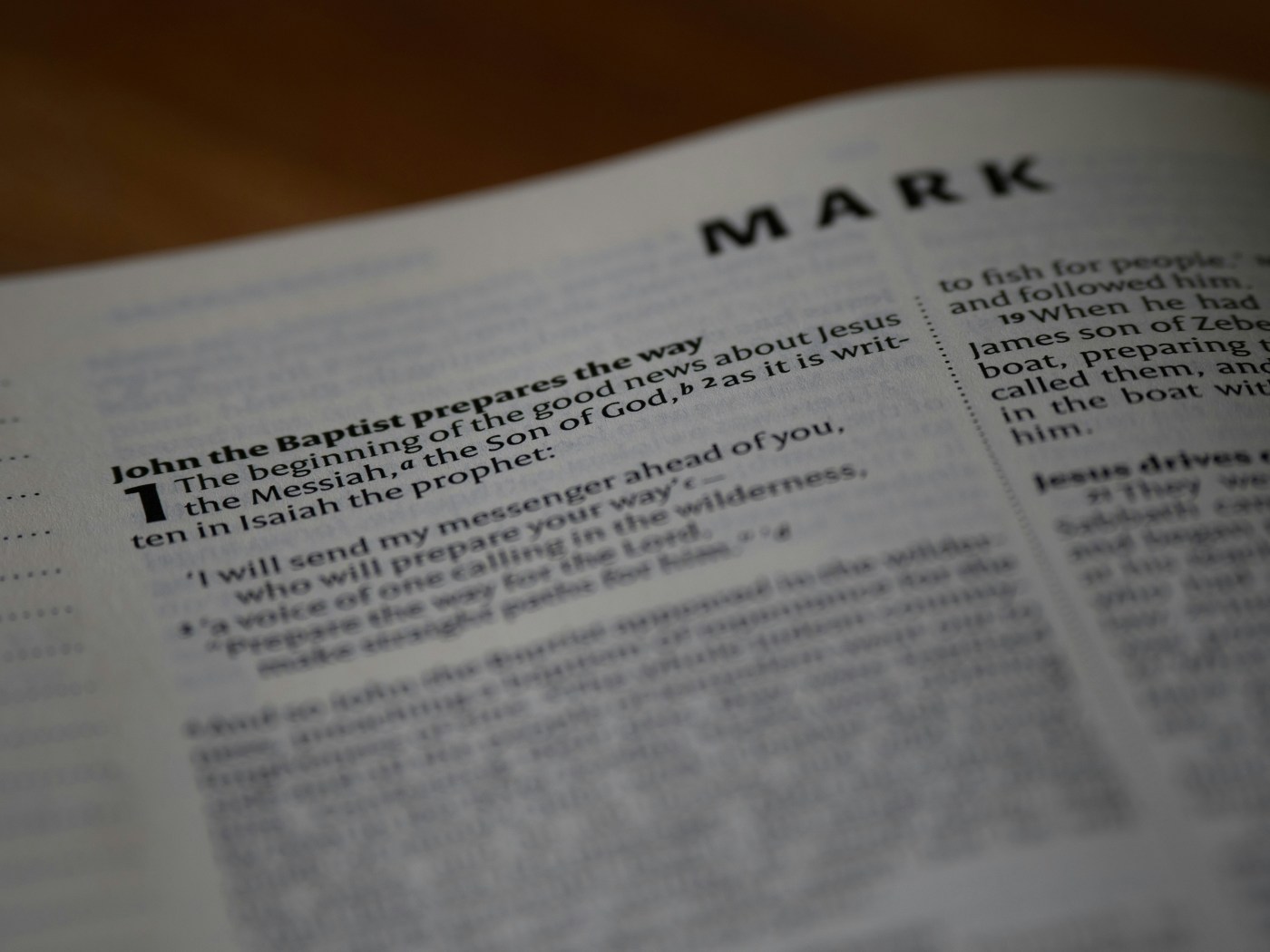
As we step into Year B, we enter the world of Mark’s Gospel, and Mark wastes no time easing us in.
Matthew gives us genealogy and fulfillment. Luke gives us poetry and songs. John gives us mystery and cosmic language. But Mark? Mark begins with urgency. Motion. Disruption.
“The beginning of the good news of Jesus Christ” (1:1).
And immediately we are moving.
Mark’s Gospel is often dated around 70 CE, and I tend to lean firmly into that date because it helps us hear the tension and desperation pulsing beneath the text. Jerusalem has fallen. The Temple has been destroyed under Rome’s violence. The center of religious, political, and communal life has been shattered. The world Mark’s community knew is coming apart.
And Mark writes like someone trying to tell the story before the walls finish falling.
Mark’s favorite word is “εὐθὺς” (“immediately”). Jesus is constantly moving from place to place, encounter to encounter, crisis to crisis (1:10, 12, 18, 20, 21*, 28–30, 42–43). There is little time to breathe. Crowds press in (3:7-10). Demons scream (1:23-27; 5:1-20). Disciples misunderstand (4:13; 6:52; 8:17-21). Storms rise suddenly (4:35-41). The whole Gospel feels restless because the world around Mark’s community is restless.
That urgency is matched by another distinctive feature of Mark’s storytelling. He frequently uses intercalation (often called the “Markan sandwich”), placing one story inside another so that each interprets the other (e.g., 5:21-43; 11:12-25; 14:1-11). Rather than slowing the narrative down, these interruptions deepen the sense of urgency and even disorientation. One story is left hanging while another unfolds, forcing us to wrestle with both at once. The meaning is rarely stated outright. Instead, it emerges from the chaos of desperate people, fearful disciples, religious leaders, and outsiders all colliding around Jesus.
This Gospel is forged in the middle of chaos. And because of that, Mark’s Gospel often feels rawer than the others.
Mark is the first Gospel to frame Jesus’ ministry through the language of apocalypse. (13:1-37). Today, we often hear “apocalypse” as a prediction of the end of the world. But for Mark, apocalyptic language is a way of interpreting a world that already feels like it is ending. When the Temple falls, when empires wage war, when familiar institutions collapse, ordinary language no longer seems adequate. Cosmic imagery (darkened suns, falling stars, the shaking of the heavens) is not an escape from history but a way of making theological sense of history. Matthew will build on this imagery, weaving it into his prophetic tradition and parables (24–25), while Luke uses it more sparingly (21:5-36). But Mark introduces it first because his community is living through catastrophe. Apocalypse becomes the language of faith in a world that feels like it is coming apart.
In the midst of all this, it should come as no surprise, then, that Mark’s examples of faith and discipleship are rarely heroic. They are confused, frightened, impulsive, and frequently wrong. They misunderstand Jesus over and over again (4:13; 6:52; 8:14-21). Even when they witness miracles firsthand, they still struggle to comprehend what is happening. By the end, they scatter in fear (14:50).
That can frustrate our modern hearing, but it exemplifies Mark’s honesty. Mark understands that fear clouds people. Trauma disorients communities. When the world is collapsing around you, clarity is hard to come by. Faith itself can feel fragile.
Mark’s Gospel speaks to communities living in anxiety, violence, uncertainty, and exhaustion. Communities wondering whether God is still present when institutions crumble and the future feels impossible to predict. And into that fear, Mark does not offer easy comfort. He offers a suffering Messiah (8:31; 9:31; 10:32-34).
That’s one of Mark’s defining theological moves. In Mark, Jesus is powerful, yes, but that power rarely looks triumphant in the ways people expect. Again and again, Jesus resists becoming the kind of Messiah people want him to be (1:43-45; 7:36; 8:29-9:1). He heals, restores, feeds, and liberates, but he also speaks openly about suffering, rejection, and death (8:31; 9:31; 10:32-34).
In Mark, Messiahship is not about conquering or domination. It is about self-giving love. It is about carrying the cross (8:34-38). It is about serving rather than controlling (9:35; 10:42-45). It is about losing one’s life rather than grasping for power (8:35).
That is not the kind of message communities naturally gravitate toward in moments of instability. In fearful times, people usually want strength, certainty, and enemies to defeat. Mark’s Jesus keeps pointing somewhere harder: toward sacrifice, humility, mercy, and trust in God even when the road leads through suffering.
And yet, Mark is not hopeless.
Even amid its urgency and darkness, this Gospel pulses with the conviction that the kingdom of God is already breaking in. Not someday. Not after everything gets fixed. Now (1:14-15).
Tiny moments reveal it constantly: a healing touch (1:29-34), bread shared in the wilderness (6:30-44; 8:1-10), a forgotten woman restored to community (5:25-34), a storm calmed (4:35-41), a child embraced (9:36-37), a demon silenced (1:23-27), a woman refusing to let go of hope (7:24-30).
The kingdom arrives not through domination but through quiet restoration. And Mark insists that discipleship means participating in that work even when we are afraid (8:34-38; 10:42-45).
Mark never pretends courage comes easily. And that’s seen especially in Mark’s ending. The earliest manuscripts stop with the women fleeing the empty tomb in fear and silence (16:1-8). No resurrection appearances. No triumphant finale. Just trembling astonishment.
For many, that ending feels abrupt and unsatisfying. But maybe that’s precisely the point. Mark hands the story to us from there. Will fearful disciples continue the proclamation anyway? Will communities under pressure continue embodying the kingdom? Will people still trust that resurrection is possible in a world shaped by death?
Mark refuses to tie everything up neatly because life rarely works that way. And perhaps that is why Mark remains such a timely Gospel.
We, too, know what it feels like to live in anxious times. We know institutional uncertainty. We know political violence. We know exhaustion. We know the temptation to seek safety through power, fear, or division. Mark speaks directly into those realities. Not with denial. Not with shallow optimism. But with the stubborn insistence that even here, especially here, God is still at work.
As we journey through Year B together, this is the lens Mark gives us: A Gospel that moves quickly because the world feels urgent. A Messiah who meets suffering rather than avoiding it. A kingdom breaking in through compassion, healing, and self-giving love. A story unfinished enough that we are drawn into it ourselves.
Mark does not invite us to certainty. Mark invites us to follow with trust into the unknown.


Leave a Reply